Categories
2023-2024

Lienzos de Piedras / Canvases of Stone

APRIL 24, 2024 – JUNE 14, 2024

LIENZO DE PIEDRA CANVAS OF STONE

With Fabio Esteban Amador

Hosted by Dominique Rissolo

“Lienzo de Piedras” / “Canvas of Stone” is a photographic journey through the Pool Tunich cave system of Quintana Roo, Mexico. These images were taken during a month-long expedition through the system, captured in a vibrant palette of light and shadow intended to evoke the qualities and values of the caves’ historical use and cultural significance. Photographs of cave features intermingle with a navigable projection of LIDAR point clouds that recreate the system in 3D.

The Maya viewed the cave as an entrance or portal to the Underworld, a real and mythological place associated with emergence and fertility. Today, these spaces exist in close proximity to large-scale infrastructure projects. Through a union of art and technology, “Canvas of Stone” is part of an ongoing effort to document and preserve this part of Mexico’s cultural heritage for posterity.

During course of his work in the region, Amador has collaborated with researchers at the Qualcomm Institute, and the stewards of the cave – Grupo Rio Secreto, with the support of El Centro Investigador del Sistema Acuífero de Quintana Roo (CINDAQ) and Mexico’s National Institute of Anthropology and History.

Fabio Esteban Amador is an archaeologist and a visual artist originally from El Salvador. By merging art and science he continually is crafting a visual language that infuses his multi-media art, murals, paintings, photography and short film. He studied fine arts at the Art Student League of New York and School of Visual Arts. He continued studies at Rutgers and earned a Master’s and Ph.D. in Mesoamerican archaeology from the State University of New York at Buffalo. His doctoral research focused on excavating and mapping Maya sites across the states and regions of the Northern Yucatan peninsula and Quintana Roo, Mexico to investigate how groups established their identity through art and iconography. Later work has also included locations throughout Maya regions of El Salvador, Honduras and Guatemala. He was founding member of OLAS (Latin American Underwater Archaeology Organization) and a research associate at INA (Institute for Nautical Archaelogy). Fabio Esteban has also operated as a program and science officer for the National Geographic Society and has contributed to National Geographic Mundo’s television series Mysteries of the Underworld. His work has been published and exhibited by the National Geographic Magazine, iWatch Magazine, Tres Tiempos Magazine, The NatGeo Museum in Washington, Museo de Antropología David J. Guzman in San Salvador, the International Center for the Arts in Spartanburg, SC and NatGeo’s online Explorer’s Journal.

Gallery QI would also like to acknowledge Scott McAvoy for his help towards producing a visualization of Pool Tunich, and Grupo Rio Secreto for partnering in capturing the data of cave system used in the project.


Gallery QI - Lienzo De Piedra Canvas of Stone

Lorem ipsum dolor sit amet, consectetur adipiscing elit. Ut elit tellus, luctus nec ullamcorper mattis, pulvinar dapibus leo.

Categories
2023-2024

Distributed Consciousness

POSTER

JANUARY 25 – MARCH 20, 2024

DISTRIBUTED CONSIOUSNESS

WITH MEMO AKTEN

HOSTED BY AMY ALEXANDER AND JORDAN CRANDALL

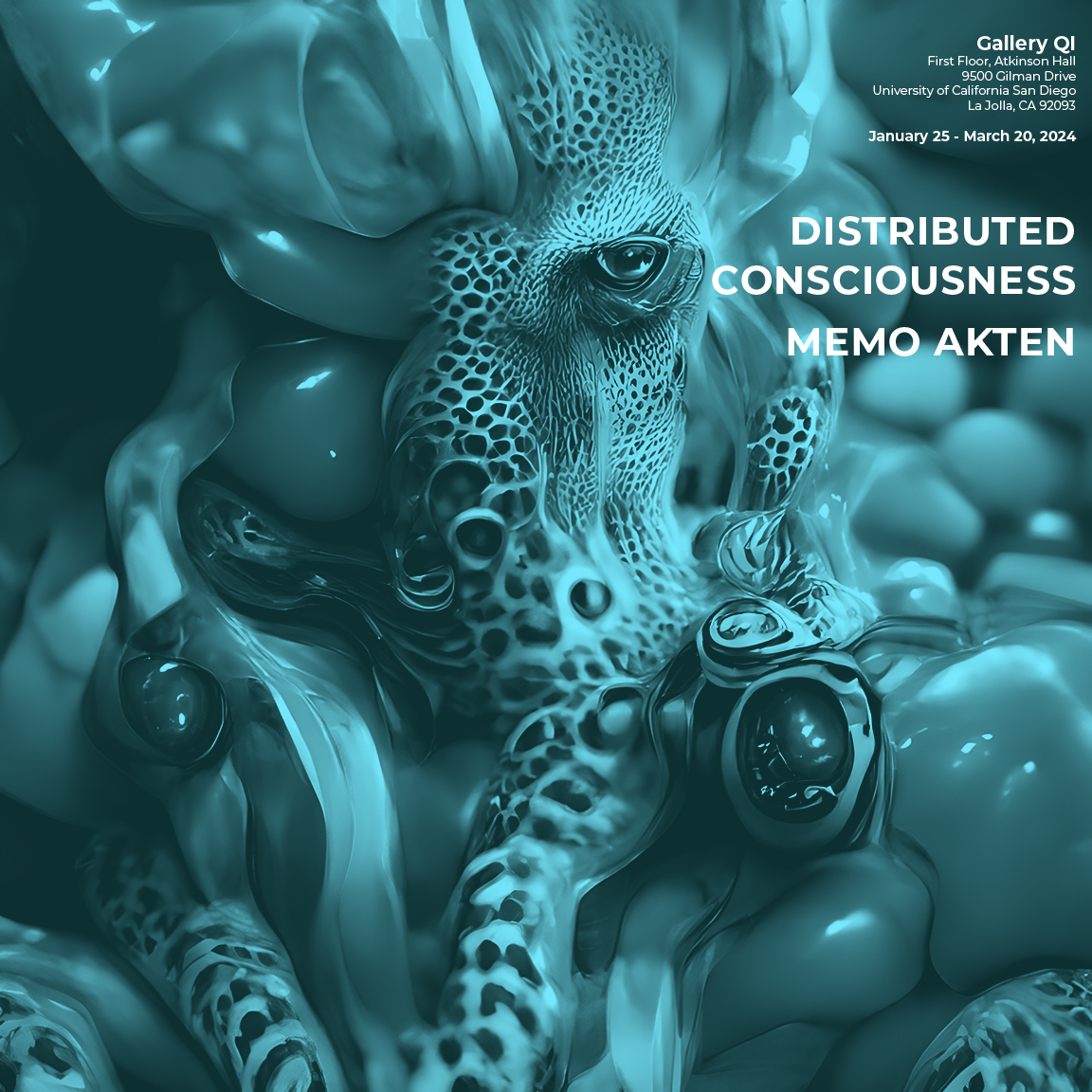
Staged as a place of ritual and worship, “Distributed Consciousness” is a speculative reimagining of a new set of mythologies and deities that guide us towards a decentering of human exceptionalism.

Drawing upon the collaborative nature of knowledge building, the collective nature of intelligence, and the permeable and dynamic boundaries between individuals, “Distributed Consciousness” employs cephalopods and cephalopod cognition as a means of reflecting upon the increasingly powerful and pervasive synthetic alien intelligences we are building in the form of Artificial Intelligence (AI), especially those trained on our collective consciousness scraped from the internet.

As we face the challenges of the climate crisis and ecological devastation fueled by anthropocentric, extractivist ideologies, the work invites us to let go of the destructive dichotomy of “Man vs Nature”, and instead embrace the interconnectedness of all human, non-human, living and nonliving things across manifold scales of time and space, and actively work towards multi- species flourishing.

Distributed Consciousness was originally developed in 2021, as an NFT collection and a series of site specific installations. Here it is being shown in a new format specific to Gallery QI.

Memo Akten is a multi-disciplinary artist, musician, and researcher creating Speculative Simulations and Data Dramatizations investigating the intricacies of human-machine entanglements. His work explores perception and states of consciousness; the tensions between ecology, technology, science and spirituality; and for more than a decade he’s been working with Artificial Intelligence, Big Data and our Collective Consciousness as scraped by the Internet,

to reflect on the human condition. He writes code and uses algorithmic / data-driven design and aesthetics to create moving images, sounds, large-scale responsive installations and performances. He holds a PhD from Goldsmiths University of London, specializing in artistic and creative applications of Artificial Intelligence, and he is currently Assistant Professor of Computational Art at University of California San Diego (UCSD).

Akten has received numerous awards including the prestigous Prix Ars Electronica Golden Nica. His work has been widely exhibited and performed internationally at venues such as The Grand Palais, The Barbican, The Royal Opera House, ZKM Center for Art and Media, Sonar Festival, Moscow Museum of Modern Art, Shanghai Ming Contemporary Art Museum and many others. He has been featured in major publications such as Wired, The Guardian, Dazed, Nowness,
The Financial Times, and he has collaborated with celebrities such as Lenny Kravitz, U2, Depeche Mode and Professor Richard Dawkins. He has served as mentor and jury on numerous international awards, residencies and conferences such as SIGGRAPH, Ars Electronica, and Google Arts and Culture.

Categories
2023-2024

Border Crossers

POSTER

OCTOBER 5 – DECEMBER 8, 2023

BORDER CROSSERS

WITH CHICO MACMURTRIE AND AMORPHIC ROBOT WORKS

HOSTED BY RICARDO DOMINGUEZ

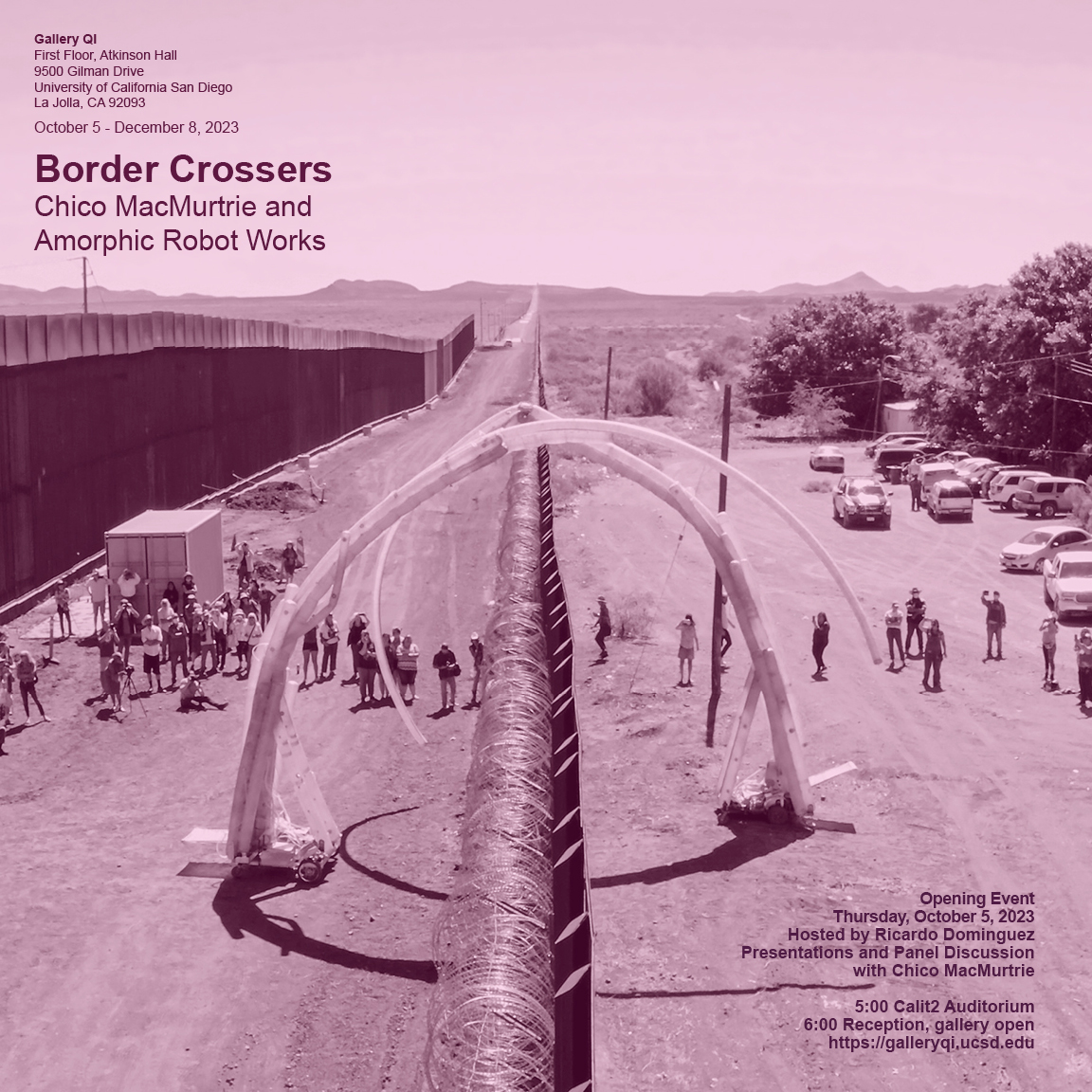
The “Border Crossers” exhibition focuses on MacMurtrie’s recent inflatable projects: “Border Crossers” and “Dual Pneuma,” including one of his robotic “Border Crossing” sculptures, along with videos and drawings of the “Border Crossers” and “Dual Pneuma.” 

Both projects channel MacMurtrie’s aesthetic and political concerns into speculative interventions at or along the U.S.-Mexico border. While his “Border Crossers” inflate over the border fence from both sides at once as a gesture of connection between two countries, the “Dual Pneuma” sculpture embodies the idea of a fluid cultural identity. “Dual Pneuma’s” imagined Fronterizx identity is distilled in its mirrored form and infinite flexibility.

Part of MacMurtrie’s time at QI will be spent working toward a “Border Crossers” performance at the San Diego/Tijuana border while continuing research and development of the “Dual Pneuma” project in conjunction with Associate Professor Mike T. Tolley and graduate students Shenglin Yang and Allyson Chen of UC San Diego’s Department of Mechanical and Aerospace Engineering and the Bioinspired Robotics and Design Lab, and Bill Bowen of Amorphic Robot Works.

“Dual Pneuma” is produced by the UC Irvine Beall Center for Art + Technology and will be exhibited in “Future Tense: Art, Complexity and Predictability” at the Beall Center as part of Getty’s PST ART: “Art & Science Collide” from September – December 2024.

Chico MacMurtrie’s work pushes the boundaries between robotic sculpture, new media installation and performance. After receiving an M.F.A from UCLA, he became known for his anthropomorphic, computer-controlled sculptures, which evolved over the years into a “Society of Machines.” Today, operating out of a studio in Brooklyn, New York, also known as the “Robotic Church,” MacMurtrie is internationally recognized for his “Inflatable Architectural Bodies” series, which explores the underlying essence of movement and transformation in organic and non-organic bodies. Freestanding or suspended in mid-air, these servo-pneumatic “soft machines” inflate and deflate through an articulated series of movements, depicting imaginary molecular and cellular formations on a magnified scale.

MacMurtrie has received numerous awards for his experimental new media artworks, including five grants from the National Endowment for the Arts, the Andy Warhol Foundation Grant, the Rockefeller Foundation Fellowship, VIDA Life 11.0, and Prix Ars Electronica, the Guggenheim Fellowship, the Mapfund Grant, the New York Fellowship for the Arts and the MAAF Grant. MacMurtrie/ARW’s works have been presented in major museums and venues around the world, including the National Art Museum of China (NAMOC), Beijing; Hayward Gallery, London; Museo de la Reina Sofia, Madrid; Cité des Sciences et de l’Industrie, Paris; Museo Universitario de Arte Contemporáneo (MUAC), Mexico City; Pioneer Works, Brooklyn, NY; Shanghai Biennale; Tri Postal, Lille, (retrospective exhibition), Muffatwerk, Munich;
Ex-Dogana, Rome, ZHI Art Museum, Chengdu; Museum of Contemporary Art, Tucson, AZ; Rubin Center for the Visual Arts (UTEP), El Paso, TX; Queens Museum, Queens, NY and the Bronx Museum for the Visual Arts, Bronx, NY.

Video

Photography

Gallery QI - Border Crossers with Chico MacMurtrie and Amorphic Robot Works