


April 3 – June 6, 2025

What does it mean to inherit a form without its original function? In The Skeuomorph, Mendi + Keith Obadike explore this question through sound, sculpture, and imagery, tracing the echoes of technology, language, and memory.
At the center of the exhibition stands BLKBX (BB)—a sculptural object, a “smarter” speaker, and a speculative AI entity trained on documents of African American and African Diasporic histories, biographies, and philosophies of freedom. BLKBX challenges our relationship to knowledge, autonomy, and historical narratives. Rooted in African-American freedom struggles and Igbo cosmology, The Skeuomorph unfolds as a poetic meditation on technological agency and the myths we encode in our machines.
Through a multisensory installation featuring reimagined political speeches, archival fragments, and layered sonic environments, the exhibition invites visitors to consider how history reverberates in the present—shaping the voices we amplify, the ones we silence, and the futures we imagine.
Opening Event – Artist Talk and Panel Discussion:
Co-sponsored by the Department of Visual Arts Visiting Speaker Series, this event includes panel discussion with Louis Chude-Sokei, Professor and George and Joyce Wein Chair of English and Director of the African American and Black Diaspora Studies Program at Boston University; in addition to recently publishing The Sound of Culture: Diaspora and Black Technopoetics (2015), Chude-Sokei collaborated with Berlin based electronic artists Mouse on Mars, with whom he produced the album Anarchic Artificial Intelligence (2021). Event moderated by Amy Alexander, Professor of Visual Arts and Gallery QI committee co-chair and Robert Twomey, Assistant Teaching Professor of Visual Arts and Committee Member of the Department of Visual Arts Visiting Speaker Series. Chude-Sokei will participate via Zoom.
BIO:
Mendi + Keith Obadike are artists, composers, and writers. Their works sit at the intersection of art, music, and language and draw upon histories of experimental media art and performance. Their early collaborative works were pioneering pieces for the Internet. Many of these early internet works were experiments in form and explorations of Mendi + Keith’s concept of “social filters”. They define a social filter as a mechanism that allows or denies access to specific identities in physical or digital spaces. Since making these early digital works they have exhibited and performed at The New Museum, The Studio Museum in Harlem, The Metropolitan Museum of Art, and The Museum of Modern Art. Their projects include a series of large-scale, sound artworks that engage cities, architecture, and public space: Blues Speaker (for James Baldwin) at The New School’s University Center, Free/Phase at the Chicago Cultural Center & Rebuild Foundation, Sonic Migration at Tindley Temple in Philadelphia, Compass Song, an app for New York’s Times Square, and SlowDrag in the St. Louis Place community. Many of these projects created for physical sites ask what it means to listen in public space and explore ideas of listening communities.
Mendi and Keith have released recordings on Bridge Records and books with Lotus Press and 1913 Press. Their recent museum exhibitions include the group shows Electronic Superhighway (2016-1966) at The Whitechapel Gallery in London, I Was Raised on The Internet at The Museum of Contemporary Art Chicago, Programmed: Rules, Codes, and Choreographies in Art at The Whitney Museum of American Art and Difference Machines: Technology and Identity in Contemporary Art at The Albright-Knox Art Gallery.
Mendi and Keith served as the first artist in residence at Weeksville Heritage Center, Brooklyn where they created a commissioned work, Utopias: Seeking for a City, a sound installation. They were invited by the Netgain Partnership (Ford Foundation, Knight Foundation, MacArthur Foundation, Mozilla Foundation, and Open Society Foundations) to perform their work “Numbers Station” at the Museum of Contemporary Art Chicago. Their other honors include a Rockefeller New Media Arts Fellowship, Pick Laudati Award for Digital Art, a New York Foundation for the Arts Fellowship in Fiction, the Louis Comfort Tiffany Biennial Award, and serving as the David Tudor Composers in residence at Mills College. Their current projects include RingShout, a musical satellite, and DreamTrain, a new video and music work commissioned by American Composers Orchestra.
Keith received a BA in Art from North Carolina Central University and an MFA in Sound Design from Yale University. He is a professor in the Department of Art at Cornell University. Mendi received a BA in English from Spelman College and a Ph.D. in Literature from Duke University. She is a professor in the Department of Performing and Media Arts at Cornell University. Mendi and Keith serve on the boards of Rhizome and The Vera List Center for Art and Politics.


January 16 - March 14, 2025
Pinar Yoldaş, Catherine Eng, Gloria Montes Crosthwaite, Ana Gloria (Martha) Rodriguez, and Stanley Rodriguez for Our Worlds, Paolo Zúñiga, and Betty Delsie Bosi and the women weavers of the Holau Vaka Taumako Association
We typically understand extraction practices as the activation of speculative fantasies about sites such as a deep-ocean floor laden with mineral resources–troves of oil, or the next new medicinal medium, to be drawn and exploited. Embodied Pacific: Extraction appropriates the term to feature works that engage elemental media used for millennia, returning our senses to the surface and to regenerative botanical practices. Drawing is interpreted as a means of renewal in the repurposing of digital media that have relied on rare earth metals. The Our Worlds Weshow (woven basket) project by Catherine Eng, Gloria Montes Crosthwaite, Anna Gloria (Martha) Rodriguez, and Stanley Rodriguez foregrounds the process of making vessels from coastal juncus dyed with mineral extracts, and the extractive and regenerative nature of language and naming. The two juncus baskets woven by Gloria Crosthwaite, a renowned master weaver, filter and extract from cultural history in a process narrated through hand drawings by Gloria Crosthwaite in a process that is represented in an immersive 3D video by Eng and Crosthwaite shown in both large and small scale. Miniature holograms of fish titled in the Kumeyaay language, a project by Catherine Eng, are projected in a weaving by Dr. Stanley Rodriguez–a chii taarruurr, a fish trap that is meant to be used in the ocean. Swimming in the mouth of the trap are Kumeyaay words for tiny hologrammatical fish, ciphers of ocean sustenance. A Handwoven Future is a new work by Pinar Yoldaş consisting of three linked woven structures that together generate lipids from algae, that are needed in a new process for producing biodegradable plastic polymers, a technique devised by the artist’s BioArch Studio in 2023 through 2025. The two grapevine and plastic tubing baskets in the series, woven in a manner that is traditional to the artist’s family, are titled Incir (the Turkish word for fig), Üzüm (grape). Victoria Amazonica, the third work, is a window-like weaving that displays the channeling of the water as it courses between the two baskets. Yoldaş interprets Indigenous Western Anatolian hand-weaving techniques to extract lipids from algae using the botanical design of straw adapted to make plastic tubing function as a thermoregulatory system in a photobioreactor vessel that serves as a soft-woven home for micro-algae. Quantities of this genetically modified algae will be produced through this economically stacked system in the artist’s BioArch Studio, where the lipids will serve as a molecular precursor for the production of biodegradable plastic polymers. These baskets, made with the help of the artist’s community in Turkey, are photobioreactor plants, living systems that will contribute to a handwoven future further imagined in Kara-tas, one of a series of Caran d’Ache undersea drawing that is the backdrop to these works. In Pacific Salt (2024) and Saltworks (2016), Paolo Zúñiga focuses on one of the first minerals to be harvested by humans for consumption. The South Bay Salt Works, one of the oldest businesses in San Diego, engages in the extraction of a mineral as coveted as gold, lithium, and sugar. Presenting salt as a medium of desire and consumption, these works, which include a salt pile that invokes the continuum between extraction, sustenance, and surface aesthetics, insist on an expanded concept of media that bridges ancestral, ecological, and regenerative practices. The closing program will feature a panel discussion about the works as well as a screening of an excerpt from Long Live Holly 2035, a conceptual film produced by Louis Hock in 2024 that reflects on the fate of Platform Holly, a decommissioned oil rig off the coast of Santa Barbara that has been the object of speculative fantasies about reincarnations of the platform’s seeping carcass as an eco-themed attraction.

Pınar Yoldaş for Yoldas BioArch Studio, A Handwoven Future (2024).
In A Handwoven Future, Pinar Yoldas engages ocean botany, structural engineering, and plastic pollution through systems drawn from the techniques of Indigenous Western Anatolian and Kumeyaay weavers who have been innovating the art and science of botany, weaving, and basketry for more than nine millennia. A Handwoven Future incorporates a group of hand-woven basketry prototypes that together comprise a photobioreactor plant. Coursing through the plastic tubing that takes the place of fiber strands is water with a high GMO algae concentration. This mechanical circulatory system performs a carbon sequestration process that yields a type of lipids that may serve as a precursor substrate in the production of biodegradable plastic. This component in a larger system for hosting genetically modified algae (a larger project underway in collaboration with the UC San Diego Center for Renewable Materials) is part of a strategy to mitigate the consequences of increased atmospheric CO2 while stimulating the circulation of Indigenous design and knowledge systems in support of a plastic-pollution-free future.
Catherine Eng, Gloria Montes Crosthwaite, and Ana Gloria (Martha) Rodriguez for Our Worlds, Weshow: Making a Winnowing Basket, 2024.
In the mixed media work Weshow: Making a Winnowing Basket, Catherine Eng interprets the harvesting, basket-making, and drawing of Gloria Montes Crosthwaite (Kumeyaay, San Jose de la Zora) and the intercultural marketing of basketry by Ana Gloria (Martha) Rodriguez (Kumeyaay, San Jose de la Zora) in miniature holography and time-based immersive 3D video image and sound in an installation that weaves new and old media to lead us through the process of botanical and cultural extraction, interpretation, and regeneration of ancestral techniques and practices.
Paolo Zúñiga, Saltworks (2016) and Pacific Salt (2024)
Saltworks is a black and white loop through which filmmaker Paolo Zúñiga takes us to coastal, southernmost salt plant in the United States: the Chula Vista Saltworks, a facility that operates through the older traditional evaporation pools. The Pacific Ocean is the source of the water evaporated at the salt ponds, where birds, some threatened or endangered, stop off on their migratory route, prompting restoration of some of the salt ponds to marshland. The recursive loop of the film is a reflection on the mining and moving of minerals during the landscape’s phased return from industrialization.


SEPTEMBER 26, 2024 – DECEMBER 6, 2024
Works by Amy Adler, Nicolas G. Miller, Johnnie Chatman, Lauryn Smith and Jeffrey Stuker
Curated by Lisa Cartwright with Leandro Martínez Depietri
Three Lives is one of six exhibitions in Embodied Pacific, a four-year Getty PST ART: Art and Science Collide research partnership between UC San Diego Visual Arts and Birch Aquarium at Scripps Institution of Oceanography foregrounding intersections of art and science in the history of oceanography, a field that shares with photography, biography, and typography a focus on graphical forms of knowing. Led by Lisa Cartwright and Nan Renner, Embodied Pacific features multiyear projects by thirty artists working with researchers in laboratories, field sites, and archives in SoCal and the Pacific Islands. Three Lives is a curatorial effort of Lisa Cartwright, Joe Riley, Stephania Torres-Londono, Leandro Martínez Depietri, Clarissa Chevalier, and Stephania Torres-Londono sited at Gallery QI and the UCSD Library’s art gallery. These exhibitions feature work engaging with what we know, and forms of knowing, about three key figures in the history of oceanography: Easter Ellen Cupp, June Pattullo, and Anita Hall, who are the subjects of projects by artists Amy Adler, Johnnie Chatman, Nicolas G. Miller, Lauryn Smith, and Jeffrey Stuker (on view at QI) and Judit Hersko, Kimberly Heard, Chanell Stone, Lauryn Smith, and Jeffrey Stuker (on view at Geisel Library). These sister Three Lives exhibitions invite immersive engagement in questions about how we structure the histories of the hidden worlds that are the ocean and its little-known researchers. These projects recognize the power of rendering absence and the importance of interrogating our formal means of graphic documentation.
What can we know about the lives and practices of scientists for whom no adequate record remains? Inspired by writer Gertrude Stein’s modernist trilogy Three Lives (1909) and artist Amy Adler’s A Woman of No Importance (2002), the works in this double-sited exhibition approach the subjugated histories of Easter Ellen Cupp, Anita Smith Hall, and June Pattullo—scientists who would remain unseen in the history of oceanography but for a handful of archival materials held by family members and the UC San Diego Library’s Scripps Institution of Oceanography Archives. These scant records, along with a trio of short biographies drafted by librarian Deborah Day in 1999, form the basis for what we know about the lives of these influential scientists. Easter Ellen Cupp, who was the first woman to earn a PhD at Scripps (in 1934), was passed over for a job at the fledgling oceanography institute in La Jolla despite her major contribution of a diatom atlas that would become the global standard for a century. She spent the rest of her life teaching science in the San Diego public school system, a position she secured through the efforts of her life partner Dorothy Rosenbury, with whom she lived for more than half a century in a Kensington cottage where they tended rose bushes and where she pursued photography and fielded communications about her influential diatom atlas from scientists all over the world until her death in 1999. Denied her PhD by her Scripps committee, MFA ichthyologist Anita Smith Hall returned to a professorship at Hampton Institute, where she founded the nation’s first marine biology program in a historically Black college. June Pattullo, the first woman to receive a PhD in physical oceanography, arrived in San Diego with her life partner Elizabeth Strong, a fellow Marine Corps aviator with whom she tracked coastal ocean wave dynamics. When, as a professor at Oregon State, she succumbed to early onset cognitive decline, Strong completed her own PhD to continue their collaborative research.
Like the stories in Stein’s Three Lives, the works in these exhibitions are deceptively straightforward in their depictions of these women. The works by Amy Adler and Nicolas G. Miller are, at first glance, figural realism—until we notice the fact that Adler has meticulously hand-rendered in pastel the grain of the portrait photographs that serve as the iconic markers of these three careers. In her trademark style, the portraits that hang in the library, photographic copies of the pastel works, insist we take yet another step back from the aura of the original and the air of importance it imparts. The highly realist trio of scaled down figurative sculptures by Nicolas G. Miller are also the result of a process that is traditional at its core. Miller hand-sculpts the figures in “digital clay” while using photographs as references. In other words, he sculpts from observation of archival photographs, much as Adler draws from these same sources. Miller’s precise details of aspects such as expression and garments is picked up by Lauryn Smith, whose clothing patterns draw from the history of the garments worn by these women, and those she imagines for them, interpreting uniform and style reflecting the complex role these women played as public figures negotiating conflicting professional, domestic, queer, Black, and gendered expectations and roles. Johnnie Chatman’s landscapes position the figures as marked absence through the convention of the silhouette, invoking the scientific history of land survey photography, bringing this tradition and the romanticized work of American landscape artists such as Ansel Adams into open dialog with the history of documentation strategies in the field of oceanography. The theme of absence is underscored by Chanell Stone, whose ocean surface offers no figure and no gaze, and by Kim Heard, whose painting imagines the women together, in a conjectural encounter—an oceanographic table of elements whirling around them in what might be a domestic space. Jeffrey Stuker’s film underscores the fact that what appears to be realist and scientific documentation is in fact always a reflexive study in forms of representation and simulation, both about entities of oceanographic importance (diatoms, wave patterns) and about the histories of those who render knowledge of the ocean, one of the most difficult of Earth’s mediums to document and to know.

“Three Lives” by Amy Adler


APRIL 24, 2024 – JUNE 14, 2024
With Fabio Esteban Amador
Hosted by Dominique Rissolo
“Lienzo de Piedras” / “Canvas of Stone” is a photographic journey through the Pool Tunich cave system of Quintana Roo, Mexico. These images were taken during a month-long expedition through the system, captured in a vibrant palette of light and shadow intended to evoke the qualities and values of the caves’ historical use and cultural significance. Photographs of cave features intermingle with a navigable projection of LIDAR point clouds that recreate the system in 3D.
The Maya viewed the cave as an entrance or portal to the Underworld, a real and mythological place associated with emergence and fertility. Today, these spaces exist in close proximity to large-scale infrastructure projects. Through a union of art and technology, “Canvas of Stone” is part of an ongoing effort to document and preserve this part of Mexico’s cultural heritage for posterity.
During course of his work in the region, Amador has collaborated with researchers at the Qualcomm Institute, and the stewards of the cave – Grupo Rio Secreto, with the support of El Centro Investigador del Sistema Acuífero de Quintana Roo (CINDAQ) and Mexico’s National Institute of Anthropology and History.
Fabio Esteban Amador is an archaeologist and a visual artist originally from El Salvador. By merging art and science he continually is crafting a visual language that infuses his multi-media art, murals, paintings, photography and short film. He studied fine arts at the Art Student League of New York and School of Visual Arts. He continued studies at Rutgers and earned a Master’s and Ph.D. in Mesoamerican archaeology from the State University of New York at Buffalo. His doctoral research focused on excavating and mapping Maya sites across the states and regions of the Northern Yucatan peninsula and Quintana Roo, Mexico to investigate how groups established their identity through art and iconography. Later work has also included locations throughout Maya regions of El Salvador, Honduras and Guatemala. He was founding member of OLAS (Latin American Underwater Archaeology Organization) and a research associate at INA (Institute for Nautical Archaelogy). Fabio Esteban has also operated as a program and science officer for the National Geographic Society and has contributed to National Geographic Mundo’s television series Mysteries of the Underworld. His work has been published and exhibited by the National Geographic Magazine, iWatch Magazine, Tres Tiempos Magazine, The NatGeo Museum in Washington, Museo de Antropología David J. Guzman in San Salvador, the International Center for the Arts in Spartanburg, SC and NatGeo’s online Explorer’s Journal.
Gallery QI would also like to acknowledge Scott McAvoy for his help towards producing a visualization of Pool Tunich, and Grupo Rio Secreto for partnering in capturing the data of cave system used in the project.

Lorem ipsum dolor sit amet, consectetur adipiscing elit. Ut elit tellus, luctus nec ullamcorper mattis, pulvinar dapibus leo.

POSTER
JANUARY 25 – MARCH 20, 2024
WITH MEMO AKTEN
HOSTED BY AMY ALEXANDER AND JORDAN CRANDALL
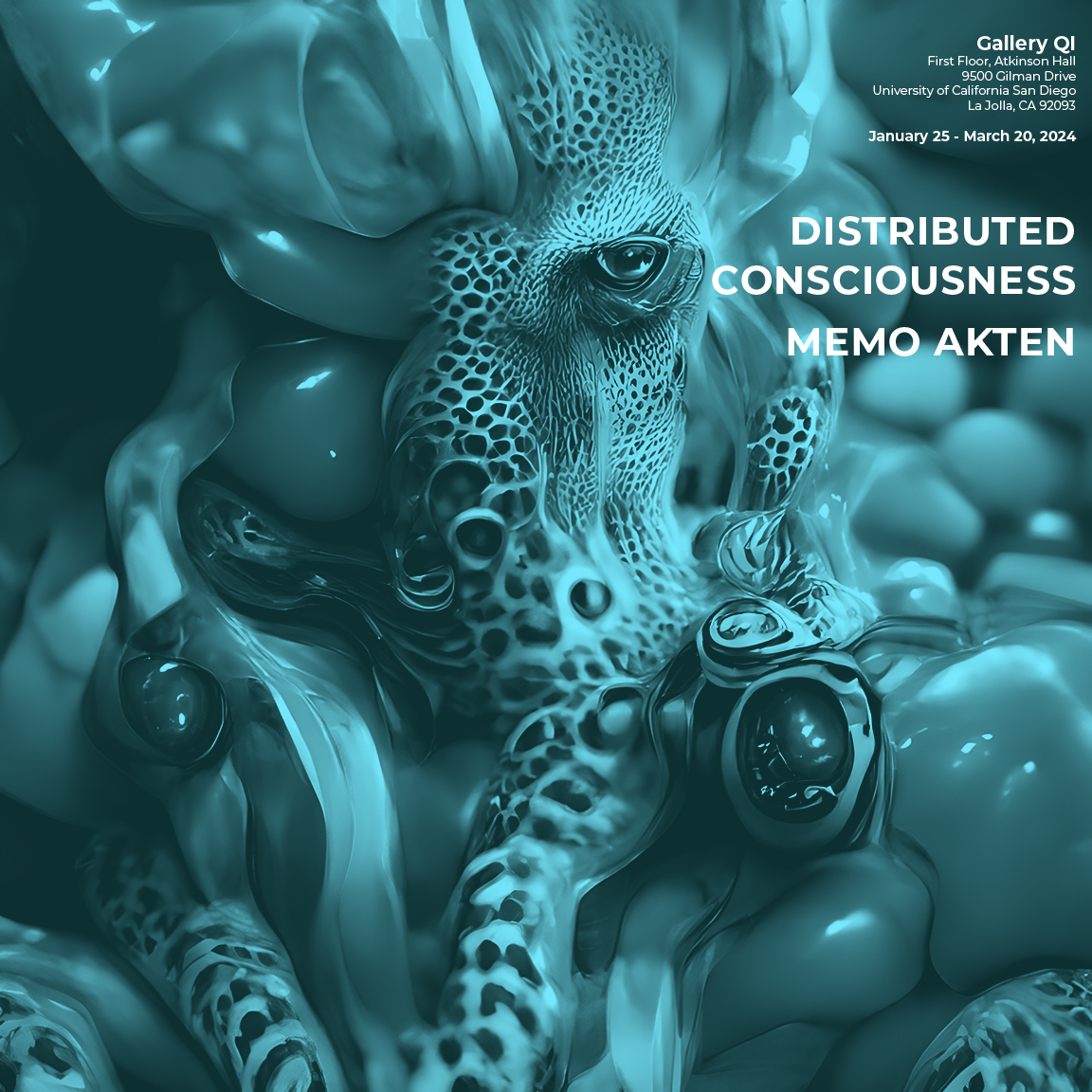
Staged as a place of ritual and worship, “Distributed Consciousness” is a speculative reimagining of a new set of mythologies and deities that guide us towards a decentering of human exceptionalism.
Drawing upon the collaborative nature of knowledge building, the collective nature of intelligence, and the permeable and dynamic boundaries between individuals, “Distributed Consciousness” employs cephalopods and cephalopod cognition as a means of reflecting upon the increasingly powerful and pervasive synthetic alien intelligences we are building in the form of Artificial Intelligence (AI), especially those trained on our collective consciousness scraped from the internet.
As we face the challenges of the climate crisis and ecological devastation fueled by anthropocentric, extractivist ideologies, the work invites us to let go of the destructive dichotomy of “Man vs Nature”, and instead embrace the interconnectedness of all human, non-human, living and nonliving things across manifold scales of time and space, and actively work towards multi- species flourishing.
Distributed Consciousness was originally developed in 2021, as an NFT collection and a series of site specific installations. Here it is being shown in a new format specific to Gallery QI.
Memo Akten is a multi-disciplinary artist, musician, and researcher creating Speculative Simulations and Data Dramatizations investigating the intricacies of human-machine entanglements. His work explores perception and states of consciousness; the tensions between ecology, technology, science and spirituality; and for more than a decade he’s been working with Artificial Intelligence, Big Data and our Collective Consciousness as scraped by the Internet,
to reflect on the human condition. He writes code and uses algorithmic / data-driven design and aesthetics to create moving images, sounds, large-scale responsive installations and performances. He holds a PhD from Goldsmiths University of London, specializing in artistic and creative applications of Artificial Intelligence, and he is currently Assistant Professor of Computational Art at University of California San Diego (UCSD).
Akten has received numerous awards including the prestigous Prix Ars Electronica Golden Nica. His work has been widely exhibited and performed internationally at venues such as The Grand Palais, The Barbican, The Royal Opera House, ZKM Center for Art and Media, Sonar Festival, Moscow Museum of Modern Art, Shanghai Ming Contemporary Art Museum and many others. He has been featured in major publications such as Wired, The Guardian, Dazed, Nowness,
The Financial Times, and he has collaborated with celebrities such as Lenny Kravitz, U2, Depeche Mode and Professor Richard Dawkins. He has served as mentor and jury on numerous international awards, residencies and conferences such as SIGGRAPH, Ars Electronica, and Google Arts and Culture.

